
History and current uses are sourced below. Founder lessons are our editorial analysis.
The tire that makes you look twice
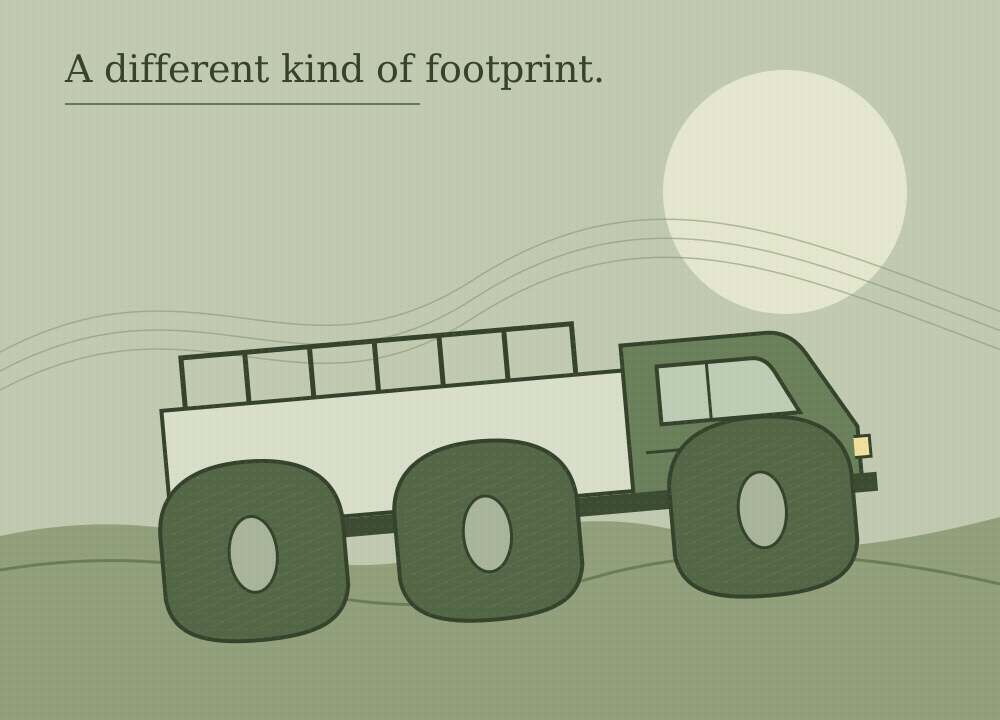
Picture a truck riding on tires that look more like giant cushions than wheels. It seems like a clever invention that disappeared. Rolligon took a different path: it found a specialized job.
The enormous wheels make a memorable demonstration. But the useful question for a founder comes after the surprise: what problem would make a customer choose them?
The spark: spread the load
A heavy vehicle on soft ground can sink when its weight is concentrated beneath ordinary wheels. Rolligon’s approach used large, flexible, low-pressure rollers to spread that load over a larger footprint. Think of pressing a fingertip into a cushion, then laying your whole hand across it.
William H. Albee filed his patent in 1952. By 1956, Goodyear engineers were discussing flexible tire surfaces, inflation control, and field testing in an SAE paper. The strange-looking invention had serious engineering behind it.
Early rollers and later low-ground-pressure tires are not identical mechanisms. What connects them is the job: carrying loads over ground that makes conventional travel difficult.
It found a job beyond the spectacle
Rolligon did not simply vanish. NOV currently lists Rolligon all-terrain, low-ground-pressure vehicles. A 2024 proposal for the Inuvik–Tuktoyaktuk Fiber Line also describes a cable plough based on a Rolligon vehicle for northern ground conditions.
That proposal is evidence of a specific application, not proof the project was completed as planned. Together, these sources show something more useful than a tidy failure story: an unusual idea with a specialized working life.
For an operator moving equipment to a difficult site, the question is not whether the tires look odd. It is whether they help finish the job. Access preparation, recovery equipment, maintenance, and transport all belong in that calculation.
The lesson: find the expensive problem
Our reading of Rolligon is about finding a customer whose difficult problem makes an unusual solution valuable. A product does not need to appeal to everybody if a smaller group has a strong enough reason to use it.
That is a hypothesis to test, not a guarantee. We do not have the financial evidence to explain exactly why Rolligon remained specialized or to claim uninterrupted profitability.
Could a specialist operator help restoration crews reach waterlogged sites? Could a service reduce access costs for remote maintenance? Those are questions worth investigating alongside existing suppliers, terrain limits, and environmental requirements. Low ground pressure alone does not establish low environmental impact.
Start with five operators who face the same access problem. Ask about their last difficult job, their workaround, and its real cost. Then consider a small trial using existing equipment through an experienced operator. Agree on what improvement would justify switching before running the test.
The next opportunity might be a service built around an existing machine. Before reinventing the wheel, find out who needs a better way to get somewhere.
Sparked. A specialized idea that endured.
The documented opportunity is off-road mobility. A new business would need a specific advantage over the vehicles and services already available.
Sources & further reading
Sources and further reading. Primary records, manufacturer information, and secondary coverage are identified below.
- William H. Albee — US2714011A, filed 1952; published 1955 ↗
Primary patent record for the early flexible-roller design. A patent documents a proposed invention, not commercial performance.
- C. J. Ford and L. U. G. Nilsson — Goodyear Rolligon Tires: A New Approach to Vehicular Mobility (SAE, 1956) ↗
Primary engineering source. The public abstract was reviewed; the full paper requires paid or institutional access.
- Industrial Design, December 1957 — specialized equipment feature (printed pages 102–103; PDF) ↗
Contemporary trade coverage of Albee's vehicle, preserved in the USModernist archive.
- NOV — All-Terrain Low-Ground Pressure Vehicles ↗
Current manufacturer listing and specifications. Product availability is not independent evidence of profitability.
- Inuvik–Tuktoyaktuk Fiber Line — revised project description, section 7, printed page 40 (2024; PDF) ↗
Project document submitted to the Inuvialuit Water Board. Describes a Rolligon-based cable plough, earlier uses, and a proposed application; it is not a completion report.
- Jason Torchinsky — Weird Tech Friday: The Rolligon (Jalopnik, August 14, 2015) ↗
Further reading: an automotive retrospective with historical footage. Secondary reporting, included for context.
Do you think Rolligon has a specific use today? Tell us the use case—and who would pay for it.
Share your idea by email ↗contactus@ideasparked.com